

Profitability in bovine veterinary practice rarely erodes through dramatic financial losses. More often, margins are shaped by smaller operational inefficiencies — the subtle gaps that quietly accumulate over time.
Missed charges are among the most common.
They rarely trigger alarms. They rarely feel urgent. But over months and years, they create measurable financial impact.
The realities of billing in bovine medicine
Unlike clinic-based workflows, bovine veterinary care happens in mobile, fast-moving environments. Treatments are delivered across farms, often involving multiple animals, conditions, and decisions within a single visit.
Veterinarians work in barns, parlors, feedlots, and farm lanes. They diagnose, treat, dispense drugs, communicate with producers, and move quickly to the next task. Billing frequently becomes something that happens later — sometimes hours later, sometimes at the end of the day.
In that gap, omissions naturally occur.
A drug dispensed but not recorded.
A procedure performed but not invoiced. A treatment remembered imperfectly.
Even highly organized clinicians encounter these challenges. Not because of negligence, but because memory-based workflows are inherently fragile.
Why missed charges are so difficult to see
Missed charges rarely appear as obvious errors. There is no single dramatic loss event. Instead, practices observe gradual symptoms:
Revenue per visit feels slightly lower than expected.
Inventory counts don’t perfectly reconcile.
Margins tighten subtly.
Financial performance feels harder to explain.
Because losses are incremental, they are easily normalized.
A missed charge here and there feels insignificant. But a handful of small omissions per day, multiplied across weeks, months, and multiple veterinarians, becomes meaningful revenue leakage.
This is not a discipline problem
It’s important to recognize that missed charges are rarely a personnel issue.
Bovine practice environments are cognitively demanding. Multi-animal treatments, interruptions, field conditions, and time pressure all increase mental load. Even the most disciplined clinicians cannot eliminate the natural limitations of recall.
When billing depends on remembering what happened hours earlier, omissions are inevitable.
This is fundamentally a workflow design issue.
The compounding effect of small gaps
Small inefficiencies repeated consistently produce disproportionate impact:
- Underbilling becomes normalized
- Revenue capture becomes inconsistent
- Inventory tracking becomes less reliable
- Financial forecasting becomes less precise
Over time, practices may unknowingly undervalue their own clinical activity.
The hidden operational consequences
Missed charges do more than reduce revenue. They also erode operational clarity.
When treatments, drug usage, and billing are inconsistently linked, practices lose visibility into:
- True visit value
- Drug utilization patterns
- Service profitability
- Herd-level care trends
Financial accuracy and clinical documentation are deeply connected.
Why field-first workflows matter
The most effective way to eliminate missed charges is not stricter discipline — it is tighter system integration.
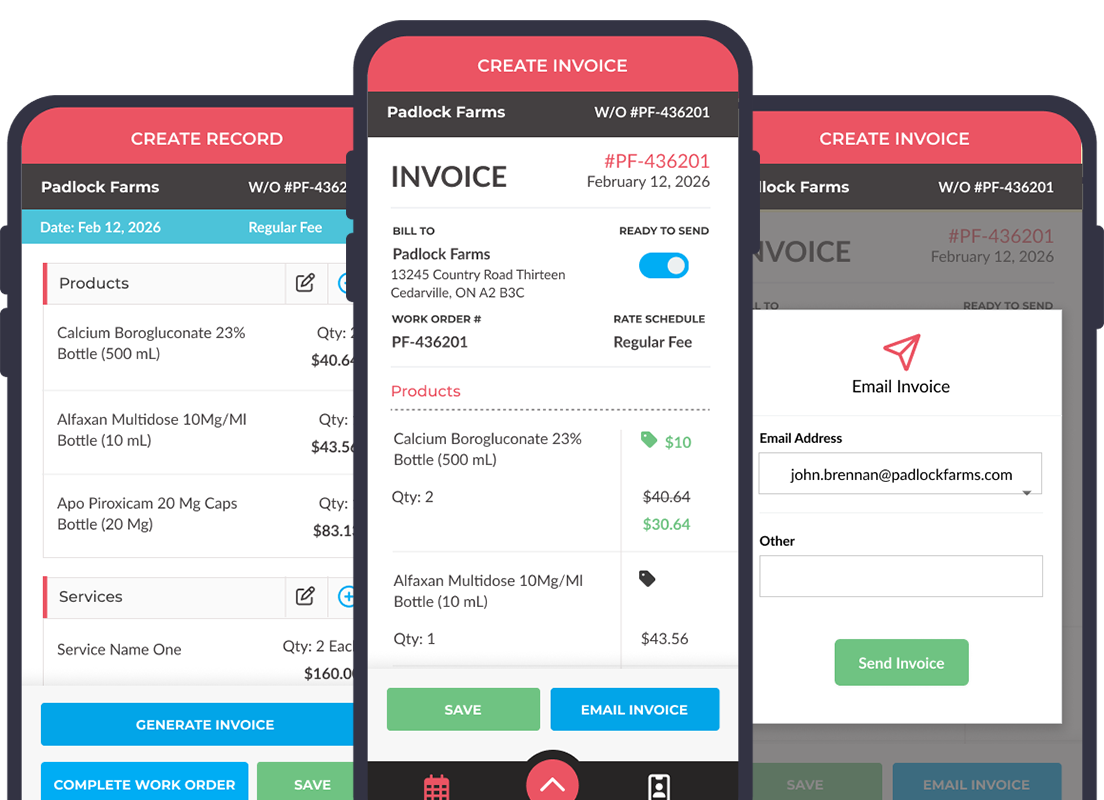
When treatments, inventory usage, and invoices are connected directly at the point of care, billing becomes a natural outcome of clinical work rather than a separate administrative task.
Actions taken in the field automatically translate into records and charges.
Memory is removed from the equation.
VetLogix as operational infrastructure
VetLogix addresses missed charges by embedding billing directly into clinical workflow. Treatments link to inventory. Inventory links to invoices. Invoices link to records.
Nothing relies on recall. Nothing waits for end-of-day reconciliation.
Because in bovine practice, what gets treated should always get billed.
And the most reliable way to protect revenue is to remove the gaps where revenue is lost.
Stop letting small misses turn into lost revenue—VetLogix captures treatments and charges as they happen, so nothing slips through the cracks.